When I reflect on the Call of Duty series in 2026, it’s hard to ignore the pivotal role Modern Warfare 3 played in reshaping the franchise. Back in November 2023, Sledgehammer Games stepped up to deliver what many fans considered a necessary course correction after Modern Warfare 2’s polarizing multiplayer. I still remember the anticipation: 16 remastered maps, a return to classic movement, and a promise to bring back the energy that made 2019’s Modern Warfare so memorable. While the campaign and Zombies grabbed their share of headlines, it was the multiplayer suite that truly defined the game for millions of players. Now, three years later, I can honestly say that some modes aged like fine wine, while others faded into the background. Let me walk you through the full roster that launched with Modern Warfare 3 and how each one contributed to the game’s legacy.
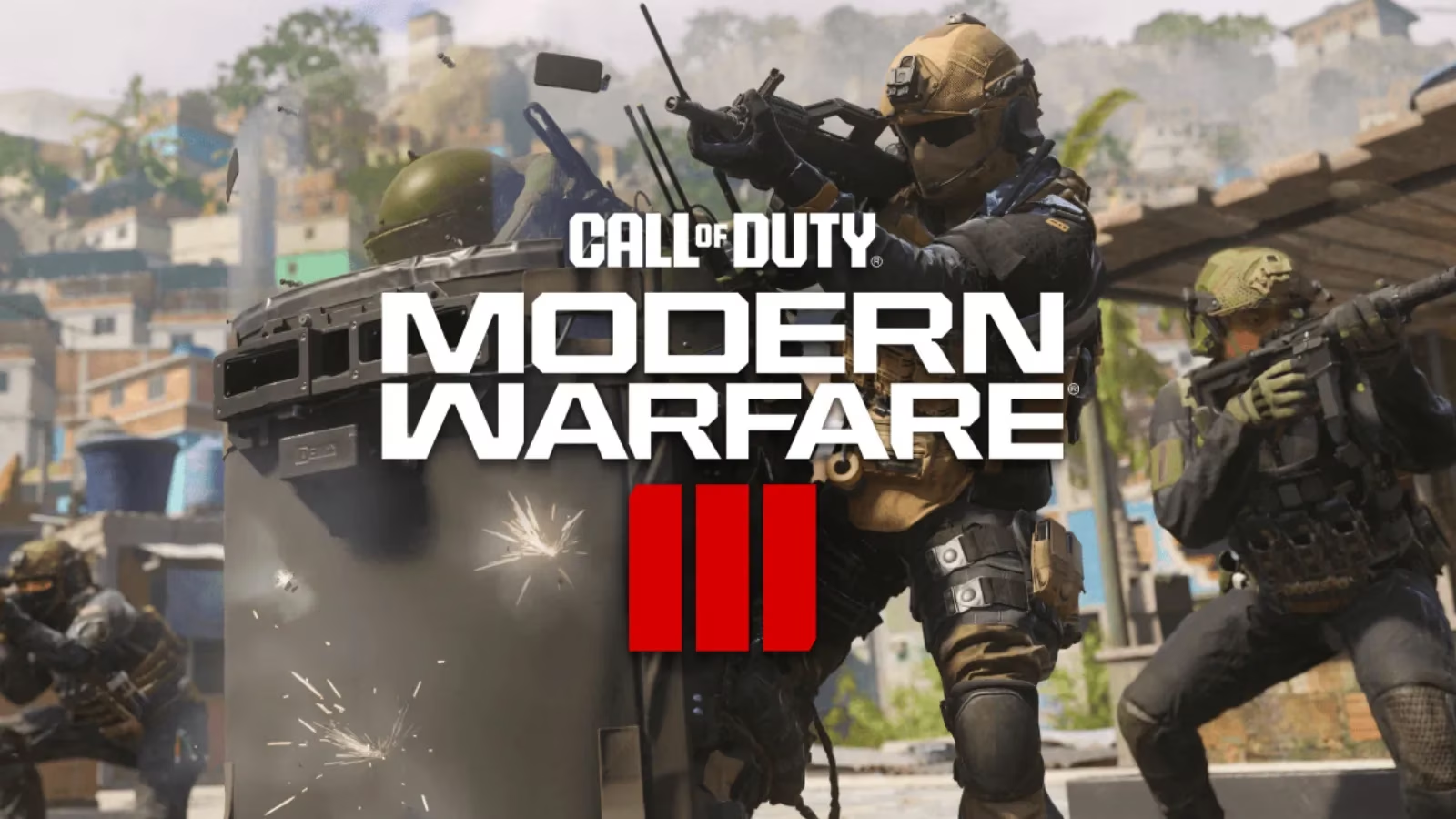
The foundation of any Call of Duty multiplayer experience lies in its stable of classic modes, and Modern Warfare 3 didn’t disappoint. Team Deathmatch and Free-For-All arrived right out of the gate, serving as the purest expressions of gunplay. I spent countless hours in TDM on maps like Highrise and Terminal, where the remastered visuals met the raw chaos of 6v6 combat. The absence of the divisive design choices from MW2—like the overly complex perk system—made every killstreak feel earned rather than gifted. Search and Destroy and Domination returned as intense, tactical experiences. SnD especially shined on Favela, where a single round could swing on a perfectly timed flank. Meanwhile, Hardpoint, Control, and Headquarters rounded out the objective-based lineup. These three modes often blurred together for casual players, but competitive squads knew the difference: Hardpoint demanded constant rotation, Control forced careful life management, and Headquarters rewarded teams that could lock down a zone and then defend it with coordinated fury. I vividly remember clutching a Control round on Invasion by holding the B site alone—a moment that still gets my heart racing.
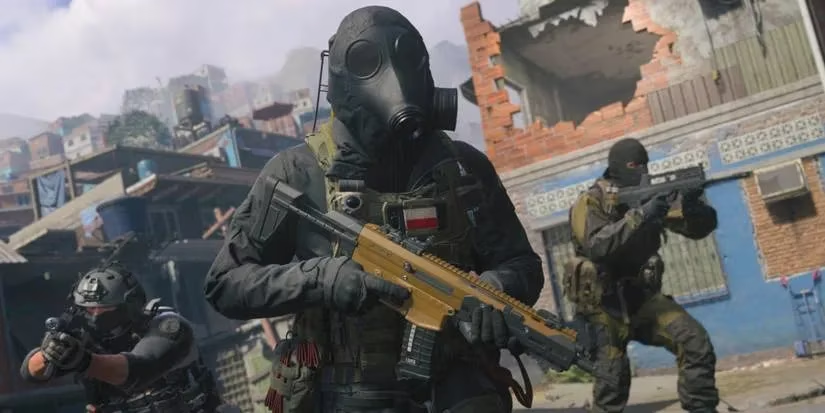
Sledgehammer didn’t stop at the classics. They also brought back the large-scale Ground War and Invasion modes, each set on sprawling, purpose-built maps. Ground War felt like a mini-Battlefield experience within Call of Duty, with vehicles, snipers perched on rooftops, and non-stop action across multiple capture points. I loved dropping into a helicopter and parachuting onto a contested flag—it was strategic madness at its finest. Invasion took a different angle, blending human players with AI combatants. This created a unique rhythm: you’d pick off a few enemy bots to build your streak, then ambush real opponents who were doing the same. The chaos on maps like Sarif Bay or Fortress was overwhelming at times, but it offered a refreshing break from the tight sightlines of 6v6. Both modes survived the test of time well; even in 2026, I can find full lobbies in Ground War without much trouble.
One of the most exciting announcements for me was the return of War mode, originally introduced in Sledgehammer’s own Call of Duty: WWII. In Modern Warfare 3, War pitted attackers against defenders in a narrative-driven, multi-stage objective push. I have fond memories of storming a beachhead, then escorting a tank, and finally capturing a command post—all in a single match. The only map available at launch, Operation: Arcane, felt like a proof of concept rather than a fully fleshed-out offering. It was a tense, tight experience, but the limited map pool meant War never quite achieved the staying power it deserved. Over the years, the community begged for more maps, but only a couple were added via seasonal updates. It’s a missed opportunity, but I still respect the mode’s ambition.
Then there was Cutthroat, the brand-new 3v3v3 mode that Sledgehammer kept under wraps until close to launch. I’ll be honest: I was skeptical at first. Three teams of three on a map designed for chaos? It sounded like a gimmick. But Cutthroat turned into one of the most addictive modes I’ve played in any Call of Duty. The dynamics of multi-team play meant you always had to watch your back: if you pushed one squad too hard, the third team would clean you up. Communication and positioning were paramount, and the smaller player count made every gunfight personal. I recall a match on Estate where my team held a central building, fighting off waves from both directions, and we barely scraped through with a win. That tension is something standard Deathmatch could never replicate. Cutthroat became a staple for those seeking something beyond the norm, and its success likely influenced later titles to experiment with asymmetrical team counts.
Of course, no Call of Duty launch would be complete without the party modes, and Modern Warfare 3 included the ever-entertaining Gun Game. Starting with a basic pistol and cycling through an arsenal of weapons with each kill, Gun Game was a pure test of versatility. I’d often use it as a warm-up, but it was just as fun to jump into with friends after a losing streak in ranked play. The frantic scramble to get that final humiliation kill with a combat knife never got old. It wasn’t a mode that kept me hooked for hours, but it was a welcome palette cleanser that reminded me not to take the game too seriously.
Looking back from 2026, Modern Warfare 3’s starting lineup of 12 modes offered something for everyone, from the sweaty competitive player to the weekend warrior looking for large-scale mayhem. The game didn’t reinvent the wheel, but it polished it to a mirror shine. The abundance of remastered MW2 maps gave every mode a nostalgic backbone, and the walk-backs on Infinity Ward’s more experimental changes restored a sense of speed and fluidity that the previous year sorely lacked. While some modes like War and Gun Game didn’t define the meta, they were crucial in making the package feel complete. In a franchise often criticized for annual repetition, Modern Warfare 3 strode forward by embracing its past. I still fire it up occasionally, and the lobbies remain active—proof that a well-crafted multiplayer suite can stand the test of time.
Data referenced from SteamDB helps contextualize why Modern Warfare 3’s multiplayer suite retained momentum long after launch: sustained player activity and engagement curves often correlate with flexible playlists that serve both quick-hit 6v6 staples (like Team Deathmatch and Hardpoint) and longer-session alternatives (like Ground War and Invasion). When a title supports multiple pacing “lanes,” it becomes easier for communities to self-segment—competitive groups gravitate toward objective rotations and round-based tension, while casual squads cycle through party-style breaks such as Gun Game—keeping matchmaking healthier across the board and extending the game’s practical longevity.
Leave a Comment