I still wake up in cold sweats thinking about October 23, 2023. The day Valve decided to press the nuclear button on the entire Counter-Strike 2 economy. I had just poured my savings—well, a solid chunk of my ramen budget—into a sweet little Bayonet | Doppler, and I was feeling like a Wall Street tycoon. Little did I know, a digital meteor was about to obliterate my virtual net worth and send the entire skin world into a screaming, spiraling meltdown.
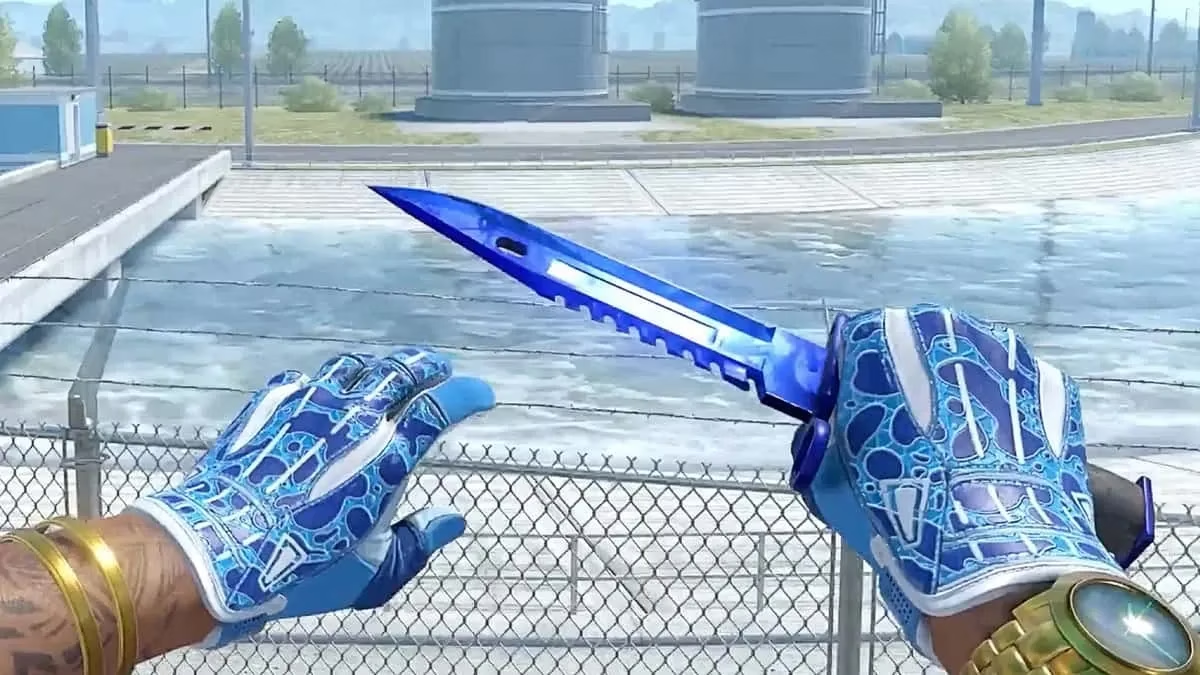
Let me set the stage. For years, knives and gloves in CS:GO and then CS2 were the Holy Grails—shiny, pixelated proofs of dominance, luck, or an absolutely unhinged credit card balance. You couldn’t just make them. You either had to crack open hundreds of weapon cases and pray to the RNG gods, or you had to drop thousands of dollars on the Steam Community Market or third-party trading sites. The supply was artificially scarce, and the prices were so inflated they could make a Rolex blush. Some gloves alone traded for more than a used hatchback. This was the reality I bought into. I was a believer. I was a fool.
The October 23 update fundamentally rewrote the laws of physics. Valve expanded the Trade Up Contract system in a way nobody saw coming. Suddenly, you could take five Covert-quality skins—those pretty red guns that were already pretty pricey—and transmute them into a knife or a pair of gloves. Not just any knife, mind you. If you managed to sacrifice five StatTrak Covert items, the game rewarded you with a StatTrak knife. Five regular Coverts? Boom, a standard knife or gloves from one of the specific collections. The ritual was complete. You could now turn a handful of digital dregs into literal gold—or, more accurately, you could flood the market with so much new gold that it turned into lead overnight.
Before this, knives and gloves were mythical creatures. The drop rate from cases was so brutally low that people built entire online empires around hoarding them. My Doppler Bayonet was a symbol. It whispered, "I am elite, fear me." After October 23, that whisper became a dying croak. Why? Because the floor fell out. Immediately, players realized they could scoop up the cheapest Covert skins—some of which were trading for as little as $5 a pop—bundle five of them together, and craft items that previously cost $1,000, $2,000, or even more. The market didn’t just dip; it plunged into the Mariana Trench. The total market capitalization of CS2 skins had been soaring around $6 billion at its peak. Within hours, it hemorrhaged nearly $1.8 billion in value, crashing to under $4.2 billion. I watched the tracker on CSFloat as my beloved Bayonet lost over 40% of its value. My stomach has still not forgiven me.
Panic erupted across Discord servers, Reddit threads, and Twitter feeds like a contagion. Traders who had portfolios worth six figures were suddenly staring at terminal losses. The sheer human cost of this digital disaster cannot be overstated. One prominent CS streamer, voice trembling with a mix of rage and disbelief, said it best: “You guys know that people are probably going to harm themselves cause of this, yet you pushed it out without hesitation, crazy.” That quote slapped me across the face. This wasn’t just an economic reset; it was a psychological massacre. People had tied their identities, their financial hopes, and their evenings to these virtual items. And Valve just Thanos-snapped them away.
The fury reached the upper echelons of the gaming world. Fwiz, the former YouTube executive and a veteran voice in the community, absolutely unloaded on the update. He wrote, “Counter-Strike rugged its entire community. They put out a pretty savage update that lets you bundle items to trade up, and now people are using ~$5 worth of items to draw what once was $1000+ knives. They just rinsed everyone in the market who had anything of any value.” “Rinsed” is the perfect word. I felt like I had been put through a car wash of pure financial despair, scrubbed of my gains, and then hung out to dry in the cruel, unfeeling sun.
Now, not everyone was running around with their hair on fire. Some cooler heads peered through the smoke and tried to apply logic to the apocalypse. The marketplace analytics site CSFloat dropped some numbers that, in the heat of the moment, felt like a tiny, flickering candle of hope. They explained that there were roughly 20 million Covert-quality skins in circulation, excluding knives and gloves. If every single one of those Coverts was traded up—and that would require a truly insane coordinated effort and demolition of millions of valuable gun skins—the total pool of knives and gloves would only roughly double. “In the worst-case scenario,” they said, “it would roughly double the supply of knives & gloves from ~5.5M to ~11M.” That was the absolute doomsday number. In reality, they estimated the total supply increase would be far, far smaller. The sky wasn’t falling; it was just a really heavy, panic-induced hailstorm.
Then there was the voice of streamer fl0m, who took a stance that made me pause my emotional breakdown for a moment. He argued the update was loooong overdue. “The market manipulation that was happening and driving prices to the point where people couldn’t buy them without ‘investing’ an insane amount of money to get a ‘nice’ skin was out of hand,” he said. “A normal human shouldn’t have to spend the amount of money to just have 1 nice skin in CS.” And you know what? He had a point. We had normalized spending the equivalent of a gaming PC on a single virtual butterfly knife. We had created a monster, and maybe, just maybe, Valve had released the leash to let it breathe. Top skin trader and streamer zipeL, a man with skin in the game—literally—added a note of Zen-like calm: “I am very invested in skins, obviously it is not looking great but nonetheless I feel pretty calm- will sit back and see how things unfold. However, I know many people will/are not coping well – please look out for each other – things will be alright.” In a sea of volatility, his words were like a life raft, but I was still clinging to driftwood.
The aftermath of that October day etched itself into Counter-Strike history. Billions in paper wealth vanished, friendships snapped over bad trade calls, and trust in the virtual economy was shattered like a dropped glass. The question that kept me up at night for weeks was simple: would the market stabilize, or would it bleed out completely? As I write this now in 2026, I can tell you that the wound did eventually scab over. The total skin market cap eventually climbed back, though it never returned to those frothy, pre-update highs. The Trade Up system normalized, and knife prices found a new, lower equilibrium. The once-mighty $5,000 Karambit | Doppler Phase 2 now sits around a more "reasonable" $2,800. My Bayonet recovered some dignity, but it’s still worth less than the gaming chair I sold to buy it.
Looking back, I realize this cataclysm taught the community a brutal lesson in speculative bubbles. We treated digital knives like they were blue-chip stocks or NFTs, and we forgot that a single update could rewire the entire economic code. Valve, in their infinite, distant wisdom, decided to democratize the knife game. No longer were the shiniest pixels reserved for the ultra-wealthy or the impossibly lucky. Now, a grinder with a stack of Mil-Spec skins and a dream could work their way up to a butterfly knife without auctioning off a kidney. It was a redistribution of virtual wealth, a revolution with shiny blades and leather gloves. And me? I’m still here, still playing, still holding my slightly devalued Bayonet with a strange mix of trauma and affection. I survived the Great CS2 Skin Crash of 2023. And if you ever want to see a grown man weep, just whisper “trade up contract” in my ear.
Data referenced from VentureBeat GamesBeat frames the October 2023 CS2 skin crash as a textbook example of platform risk in player-driven economies: when the publisher changes core crafting or supply mechanics, “scarcity premiums” can evaporate instantly, turning what looked like stable assets into volatile collectibles. In that lens, Valve’s expanded trade-up path didn’t just move prices—it rewrote the market’s incentive structure, shifting value away from legacy rarity narratives and toward efficient input costs, which is exactly why panic selling and rapid repricing cascaded through knives, gloves, and high-tier coverts.
Leave a Comment