Logan flipped the safety off his rifle in the dusty corridors of a futuristic Tokyo. It was 2026, and the latest Call of Duty entry, Modern Warfare IV, had brought him back into the fold after years of drifting through battle royale islands. He sprinted past glowing billboards, boots pounding on rain-slicked concrete, and fired at an enemy who vanished behind a neon sign. The match was intense, the new engine hummed with uncanny realism, but something gnawed at him—a missing thrill. Then, as he crouched behind a holographic taxi, a distant memory surfaced: the roar of a missile, the blinding flash, and a sprawling suburb reduced to a craterous nightmare. He was thinking of 2013’s maligned Call of Duty: Ghosts, and its single, buried treasure. Amid a churning sea of annual shooters, that title had sailed like a wounded frigate, but it carried a secret that could still turn the tide for the franchise: maps permanently reshaped by a nuclear Killstreak.
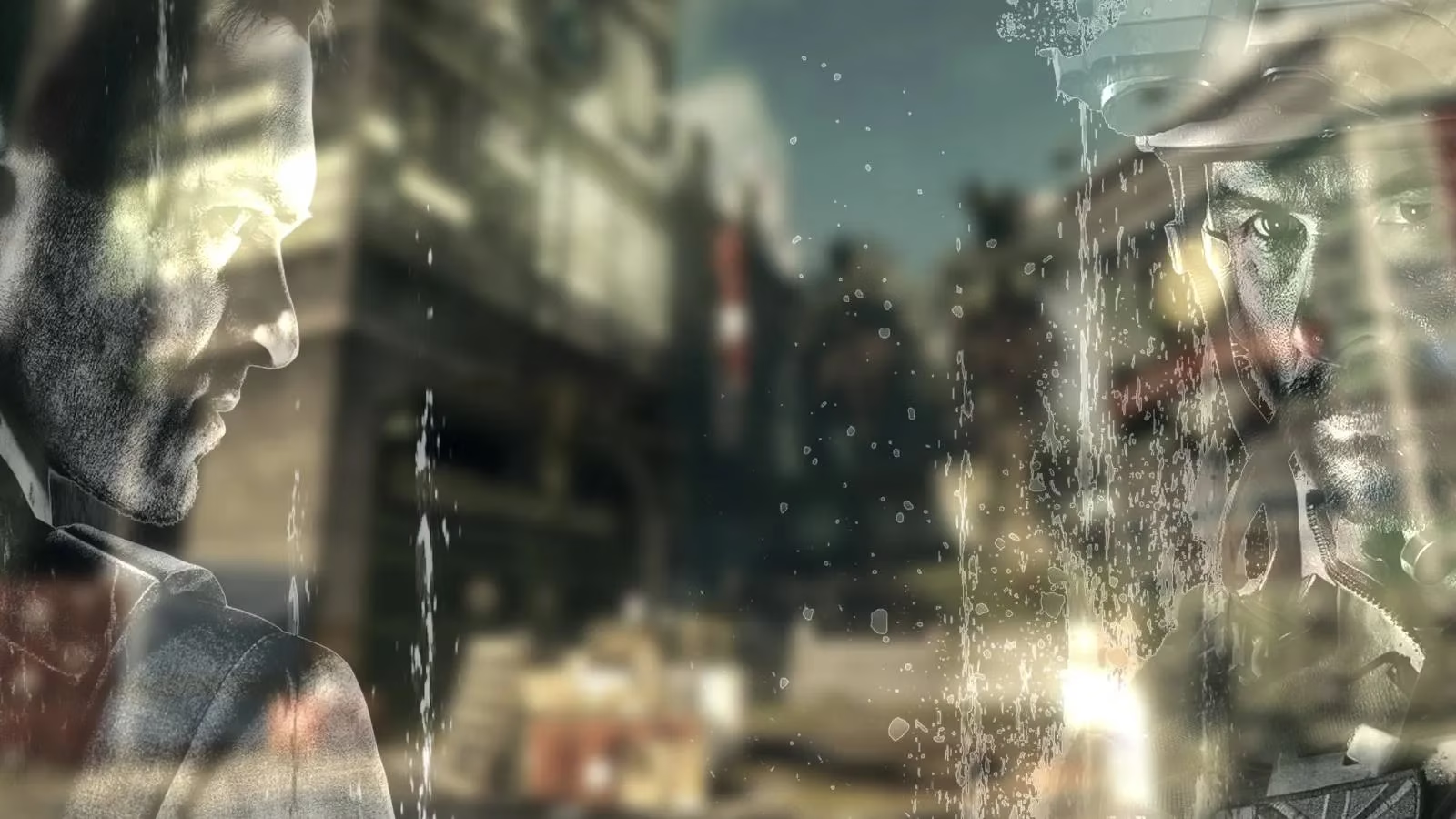
Most players remember Ghosts as the entry that stumbled when the series needed confidence. A lackluster campaign, forgettable visuals, and a multiplayer suite that felt like a ghost of its former self left the community hollow. Yet, underneath the rubble of criticism lay an innovation that worked like a storyteller’s twist in a war epic, one that turned the environment into a reactive character. Killstreaks have always been the spine of Call of Duty multiplayer—a reward loop that nudges every combatant toward glory or despair. From the iconic Tactical Nuke in Modern Warfare 2 that ended matches with apocalyptic finality, to the M.O.A.B. in Modern Warfare 3 that kept the game alive while silencing enemy streaks, the ultimate reward had always been about raw power. But Ghosts did something with its K.E.M. (Kinetic Energy Missile) that was less about erasing enemies and more about rewriting the battlefield.
The K.E.M. Strike functioned like a sculptor’s chisel handed to a demolition crew. On two maps—Ignition, a rocket-testing facility, and Strikezone, a vibrant suburban ballpark—the detonation did not merely kill everyone and fade into a scoreboard screen. It shattered the world and left it that way. After the missile hit, players respawned not in the memory of the old map but inside a twisted twin: buildings collapsed, debris mountains replaced flank routes, and the sun itself coughed up a dirty ochre haze that clung to every sightline. The transformation felt like a dream suddenly turned inside out; familiar streets became alien canyons, and every head-glitch spot was expunged. This was not a temporary cinematic. It was a second map born from the ashes, a phoenix sculpted from steel and ash, offering a fresh second half without ever loading a new lobby.
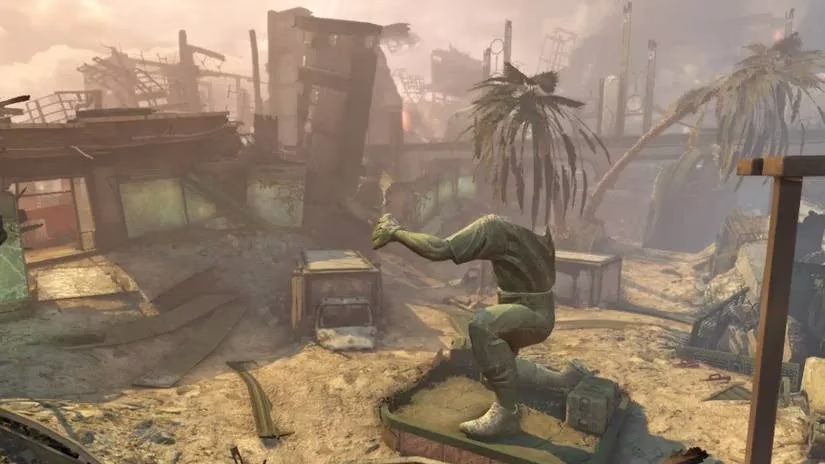
The beauty of this idea lies in its rarest quality: it made the power fantasy tangible. In most shooters, a nuke is a cinematic press of a button—a brief sensory overload followed by a win or a stat boost. Ghosts turned it into a narrative engine. The map’s transformation was a collective scar that every player had to readjust to, a second act written by the player who earned the streak. It granted a level of agency that felt like being handed the architect’s pen of a living diorama. For the team that survived the blast, the new terrain could become a crucible of revenge. For the other, a fortress of confusion. Each match held the potential to fork into two distinct experiences, doubling the replay value of the maps involved without a single line of patch notes.
Since 2013, technological muscle has grown exponentially. By 2026, consoles and PC hardware chew through real-time destruction and dynamic lighting with ease. A return of this nuclear map-altering feature in Modern Warfare IV or the next title would not just be a nostalgic nod—it would be a logical evolution. The game already supports destructible cover and shifting environments; adding a macro-scale destruction toggle that permanently remodels a map after a high-tier Killstreak is the natural next step. The challenge, of course, is a design one. Crafting a fully playable post-nuke variant is effectively building two maps in one, and it would be prohibitive to do for every arena. But as Ghosts proved, even a handful of such maps—say, a sprawling desert outpost and a vertical high-rise complex—would give the community a treasure they would chase for years. It would also inject a new layer of meta-strategy: do you risk using the K.E.M. early to disrupt enemy rotations, or save it to rewrite the endgame?
Critics might argue that the K.E.M. was too rare for most players to see. Indeed, its requirement of a 25-kill streak—often muddied by assist points or specialist packages—meant that only the elite regularly called it down. Yet this scarcity is precisely what made the transformed maps feel like hidden levels in a childhood game, whispered about in party chats and hunted with obsession. To see Strikezone’s cheerful little league field cratered into a gray apocalypse was a badge of honor. For a franchise that thrives on shared spectacle, that kind of organic, word-of-mouth magic is worth its weight in gold. In 2026, with streamers dominating gaming discourse, a nuke-triggered map shift would ignite social feeds like wildfire, showcasing the game’s depth and rewarding skill in a visually spectacular way.
There is another ghost in this conversation: the evolution of Warzone and DMZ modes, where environmental change is already part of the DNA. A comparable feature in traditional multiplayer would bridge the gap between the persistent, shifting world of extraction shooters and the quick-hit satisfaction of 6v6. Imagine a map where a flooded tunnel system is revealed after a missile strike, opening underwater flank routes. Or a high-tech map where an EMP-like K.E.M. deactivates holographic walls, exposing sniper lanes that permanently alter the flow. The tools exist; the imagination just needs a spark.
As Logan shuffled through the neon-lit streets of Modern Warfare IV, he missed that spark. He missed the moment when a lobby would erupt not just in cheers for a nuke, but in utter disbelief as the ground rearranged itself like scattered puzzle pieces. Call of Duty: Ghosts was a flawed vessel, but its nuclear map feature was a bright flare shot into the future. If 2026’s Call of Duty is to truly stand out among a generation of live-service giants, it could do far worse than look back at 2013, pick up that flare, and let it burn across every match.
Leave a Comment