In a move that has simultaneously delighted players and sparked fresh outrage among the Counter-Strike community, Valve’s newest anti-cheat trick in Deadlock has been confirmed by a former developer as a long-buried concept originally designed for CS. The feature, which allows players to turn detected cheaters into helpless frogs instead of banning them mid-match, went live in Deadlock in late 2025 and has become one of the most talked-about anti-drug systems in gaming history.
For years, the standard response to a detected cheater in online shooters has been blunt: a sudden disconnect, a VAC ban message, and an abrupt end to the match. But what if justice were not swift and invisible, but public, humiliating, and hilariously powerless? That is exactly the question Valve’s designers asked years ago, and the answer—codenamed “FU Surprise Mode”—has finally seen the light of day. Just not in the title for which it was first imagined.
A Frog Today, But Yesterday a Chicken?
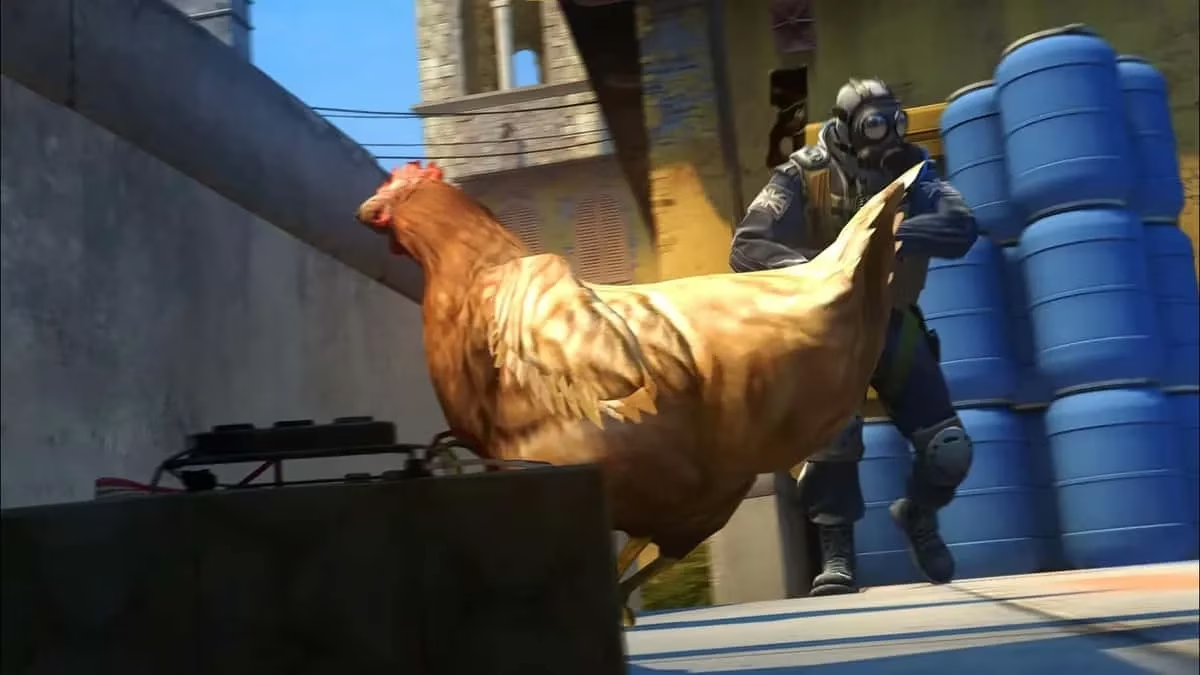
Shortly after the Deadlock update rolled out, former Valve employee Burton Johnsey took to social media to share the feature’s true origin story. “Holy crap, they finally built codename ‘FU Surprise Mode’?! When I worked on VAC, Rich and I designed this for CS but the cheater was a chicken,” Johnsey posted. He worked at Valve in 2016, deep inside the company’s anti-cheat division.
The idea was as simple as it was vindictive: instead of kicking a cheater and potentially letting them immediately jump into another match, transform the offender into a harmless, immobile animal and force them to spectate their punishment in real time. In Counter-Strike, that animal was the chicken—an icon of every map, known for pecking around Bombsite B on Dust II or awkwardly blocking the door on Inferno. A cheater turned into a chicken would be unable to shoot, plant, defuse, or even communicate. They could only cluck, strut, and endure the mockery of their teammates.
But the chicken humiliation never materialized in CS:GO or CS2. Instead, it lay dormant in Valve’s idea vault, waiting for a new title to adopt it. That title turned out to be Deadlock, the developer’s fast-growing hero shooter that has been widely described as its “favorite project.” With its fantasy aesthetic, frogs—wobbly, helpless, and comically squishable—fit the universe perfectly. The core mechanic, however, remains unchanged: when a cheater is detected mid-match, the lobby is given a choice. Ban immediately and end the game, or transform the cheater into a frog for the remainder of the round.
Why Did CS Never Get This Feature?
The revelation poses a provocative question: if the system was designed for Counter-Strike, why is it debuting in Deadlock? Johnsey’s comment implies that Rich Geldreich, another prominent Valve veteran, co-architected the “chicken mode” alongside him. It seems technical hurdles, shifting priorities, or perhaps simply the inertia of a game as massive as CS, stalled the implementation. CS2’s anti-cheat, powered by VAC Live, has received incremental updates but no transformative psychic punishment. Meanwhile, Deadlock—still in its explosive growth phase—has become the petri dish for experimental Valve ideas.
For years, CS2 players have voiced frustration that Valve pours its most creative energy into Deadlock. Frequent hero additions, map reworks, and surprise features like weather effects or destructible environments have made Deadlock the golden child, while CS2 receives cautious, competitive-focused maintenance. The frog anti-cheat system feels like another emblem of that disparity. It is not just a fun new tool—it’s a feature CS players could have enjoyed half a decade ago, dressed in the feathers of a chicken.
Community Reaction: Delight and Resentment
The Deadlock community has embraced the frog mechanic with open arms. Clips of banned players suddenly transformed into tiny, hopping amphibians before being gunned down or simply abandoned by their teams have flooded social platforms. Some players have even turned the punishment into a spectator sport, following the frog-cheater around the map while reciting Shakespearean monologues. It adds a layer of communal catharsis that a simple ban screen could never provide.
But over on the Counter-Strike side, sentiment is far less cheerful. Popular forums and subreddit threads are filled with variations of the same complaint: “Valve designed this for us first!” Many see it as yet another sign that CS2 is not the priority. Veteran players recall the era when every major Valve innovation—Matchmaking, Overwatch, VACnet—debuted in Counter-Strike. Now the pipeline appears reversed. The frog mode, while undeniably silly, underscores a deeper anxiety: if the company’s most playful and potentially effective anti-cheat idea is being given away to another title, what hope does CS2 have of regaining its spot at the top of Valve’s agenda?
The Psychology of Public Shaming in Anti-Cheat
Beyond the platform drama, the “FU Surprise Mode” taps into an evolving understanding of deterrence. Traditional bans are invisible; a cheater creates a new account and continues almost uninterrupted. But public, in-game transformation is a form of immediate, sharable shame that discourages not only the cheater but also anyone watching the stream or highlight reel. It turns the cheater into a meme. And in the modern internet economy, memes are a powerful disincentive.
If a cheater knows they risk becoming internet-famous as a helpless frog chased by laughing enemies, they might think twice before downloading the hack. Is it a permanent solution? No. Sophisticated cheat developers will always try to bypass detection. But for the casual or aspiring cheater, the threat of humiliation might carry more weight than a delayed VAC ban. In that sense, Valve’s experiment could be a model for the industry—even if it took almost a decade to see light.
Looking Forward: Could CS2 Still Get Its Chickens?
Will the chicken mode ever arrive in CS2? Given Valve’s flat corporate structure and tendency for projects to live or die by employee passion, a resurrection is not impossible. The code for “chicken punishment” likely still exists in some internal build. If a current team decides to dust it off, maybe one day a CS2 cheater will find themselves clucking helplessly on Mirage. However, given the current trajectory, such a move would be seen less as a gift and more as a consolation prize—a leftover handed down from the shinier, more favored sibling.
For now, Deadlock enjoys the glory of the frog. And each time a cheater is turned into a warty green creature and unceremoniously punted off a ledge, the Counter-Strike community can only sigh and wonder: what might have been, if only they had been chickens instead.
Leave a Comment