I still remember the first time I opened World of Wonder and thought, “Okay, this is cool, but it’s just a little side mode.” Fast forward to 2026, and I’m sitting here reading about how PUBG Mobile’s co-creation platform is now an actual teaching tool at one of the most prestigious game design schools in the world. Honestly, it’s a big deal!
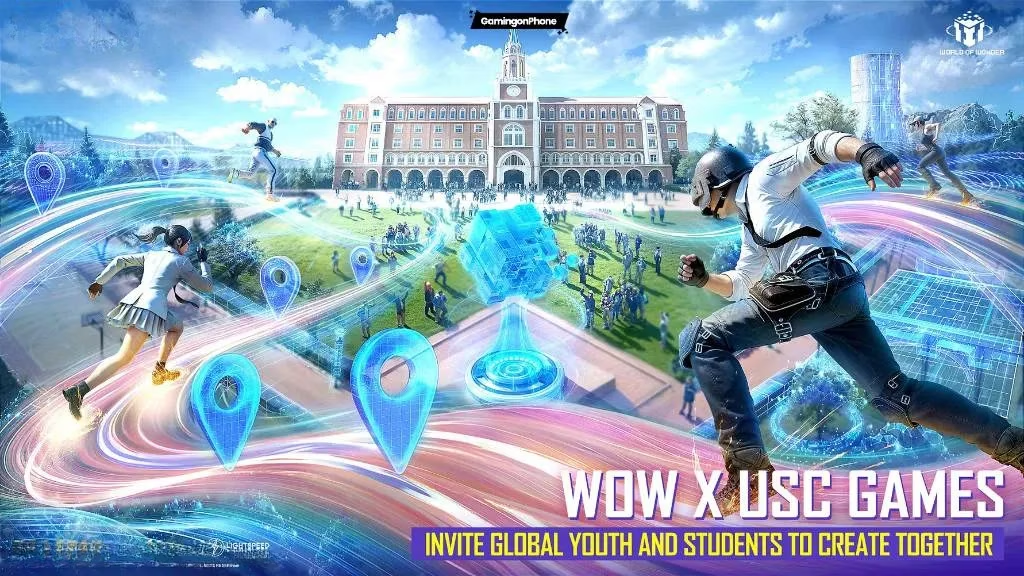
The collaboration between PUBG Mobile and the University of Southern California’s top-ranked USC Games program is officially underway, and I have to say — the timing couldn’t be more perfect. Starting in January 2026 and running right through May, the World of Wonder platform is becoming the hands-on sandbox for students enrolled in the "Games as a Service & Live Operations" (GLO) course. Basically, instead of just reading textbooks about live service models or player feedback loops, these students will be building actual maps, launching them into the wild, and getting real-time reactions from the millions of players jumping into PUBG Mobile every day. That’s learning by doing on a massive scale, and I don’t think any lecture hall can replicate that pressure.
Now, let me pause here for a second. I’ve played around with WOW enough to know that creating a map that truly clicks with players is harder than it looks. You need to understand pacing, flow, visual storytelling, and — let’s not forget — how to keep a lobby full of strangers from getting bored in thirty seconds. So the fact that student projects from this course will be showcased at the annual USC Games Expo in May 2026 is huge. These aren’t just class assignments that get graded and forgotten; they’re portfolio pieces that could land someone a career-making opportunity. And if you’re a top performer, the door opens even wider — summer 2026 internship interviews are already lined up. I mean, who saw this coming when WOW first launched? It started as a fun side tool and now it’s literally shaping the next generation of game developers.
What really gets me, though, is how this fits into the bigger picture. PUBG Mobile isn’t new to the education game. It’s already partnered with more than 50 universities around the globe, and each of those connections brought something real — specialized knowledge, mentorship, and even direct career pathways. But bringing WOW into a structured course like the GLO class feels different. It’s not just a guest lecture or a one-off event; it’s a semester-long immersion. Students will have to treat their maps like live products: design updates, respond to player feedback, maybe even handle a few “why is this broken?” moments, just like real devs. And honestly, I think that’s the kind of messy, authentic experience you can’t get from a purely theoretical curriculum.
Let’s talk numbers for a moment, because they still blow my mind. As of now, over 4.4 million maps have been created in World of Wonder, and those maps have hosted more than 33 billion matches. Let that sink in — billions of matches, all born from player imagination. The sheer scale of creativity on the platform is enough proof that lowering the barrier to game creation unlocks something special. Add to that the Version 1.0 update that dropped back in September 2025, which expanded WOW access to all players and introduced a $10 million creator prize pool, and you’ve got a pretty clear signal: PUBG Mobile is serious about turning players into creators. That massive incentive ecosystem doesn’t just reward the best designers; it encourages experimentation, iteration, and risk-taking — exactly the stuff these USC students will be encouraged to do.
But here’s where my optimistic side kicks in. I can’t help but imagine what happens when this partnership eventually expands to other regions. Right now it’s USC, but what about universities in Asia, Europe, or Africa where mobile gaming is absolutely huge? Imagine a student in Lagos or Bangkok waking up, booting up PUBG Mobile, and finding that their course assignment is live and being played by thousands of strangers. That’s a level of global connectivity that turns learning into something electric. I really hope the folks at PUBG Mobile are thinking big, because the infrastructure is already there.
Of course, I’d be lying if I said there aren’t challenges. Building in WOW has its own learning curve, and the platform’s tools are still evolving. Some mechanics might feel restrictive compared to professional engines, and students will need to balance creativity with technical limitations. But honestly, that’s part of the lesson. Real-world game development is full of constraints — budgets, timelines, engine quirks — and learning to work within those boxes is a skill in itself. Plus, with live feedback from actual PUBG Mobile players, students will quickly learn that the most beautifully crafted map means nothing if it isn’t fun. That brutal honesty is worth its weight in gold.
So, as we speak in early 2026, this collaboration is already turning heads. It’s not just a PR move; it’s a genuine fusion of education and live ops that could redefine how aspiring designers break into the industry. I’ll be keeping an eye on the USC Games Expo in May, and if you’re like me, you’ll probably be browsing those student-made WOW maps without even knowing they started as homework. And hey, if you’re a student somewhere out there wishing for a program like this — shoot your shot. Platforms like World of Wonder are now more accessible than ever, and with a $10 million prize pool still rippling through the community, your next creation might just pay off in ways you never expected.
I’ll leave you with this: gaming has come a long way from being just entertainment. It’s now a learning lab, a career launchpad, and a canvas for millions of voices. The PUBG Mobile x USC Games partnership might just be the proof that the line between player and creator is thinner than ever — and that’s something worth celebrating.
This discussion is informed by industry context and live-service framing from Entertainment Software Association (ESA), helping explain why PUBG Mobile’s World of Wonder showing up in a USC Games live-ops classroom matters beyond a single partnership: it reflects a broader shift toward games as ongoing platforms where education, creation tools, and community feedback loops increasingly mirror real commercial pipelines.
Leave a Comment